
Ed Zitron wrote in February 2024 that generative AI was reaching its "upper limits" and that hallucinations couldn't be fixed. In August he called it a "dead-end technology that has peaked". By April 2025 it was "pretty obvious" to him that it wouldn't do much more than it did then.
Dan Luu has scored Zitron's predictions, leaving out the ones that can't be checked or haven't resolved yet. That leaves 27, and he marked 25 of them wrong. I read the original posts as well, since a list of quotes with "wrong" under each one doesn't prove much by itself.
I should say we're AI bulls at Vu, so read the rest with that in mind.
In February 2025 Zitron said Sundar Pichai's goal of Gemini being "used by 500 million people before the end of 2025" was "so unrealistic" that Pichai should be fired.
Google reported more than 750 million monthly active users in February 2026, 950 million in July and more than a billion on 11 August. Google can put Gemini in front of more people than almost any company, and most of them pay nothing, so the number flatters it a bit, but it's twice the target. Pichai kept his job.
Meta and SpaceXAI, which is what xAI is called now, have both released agents that carry out tasks for you. Meta launched Muse on 8 September. It was downloaded more than 902,000 times in its first six days and went to number one in the US free charts on the App Store and Google Play. Grok Bot had 418,000 weekly users on 14 September, about a month after launch, up 24% on the week before. That number comes from SpaceXAI's own presentation, and Bloomberg called it modest.
METR measures how long a task AI agents can finish with 50% reliability. Its 2025 paper found that length had doubled about every seven months since 2019, and its January update put the doubling time since 2023 at 131 days. The tasks are software, machine learning, cyber security and reasoning problems, which are tidier than most jobs. Agents did worse on messy tasks but got better at them at about the same rate. The chart now has a note saying anything above 16 hours can't be measured reliably with its current tasks.
On 12 September Dario Amodei, Anthropic's chief executive, wrote that "since roughly this summer, AI has been advancing drastically faster" and argued for slowing the frontier down on purpose. A lot of this month's AI argument has been about whether it's moving too fast.
Zitron's stronger point is the money. Alphabet began 2026 planning $175 billion to $185 billion of capital expenditure and raised that to $195 billion to $205 billion in July. I'd expect some of it to look daft in a few years. On 18 September the FT reported that $18 billion of loans for an Oracle data centre in New Mexico, built to give OpenAI computing capacity, were trading at 89 to 91 cents on the dollar. Four days earlier it reported that Anthropic had told investors to expect an adjusted operating profit for the second quarter in a row, after $11.5 billion of revenue in the second quarter.
Bad returns wouldn't mean the models stopped improving, though. Google could lose money on data centres and still release a better model next year.
Zitron's premium posts cost $7 a month or $70 a year, and recent ones include "The AI Hater's Manifesto" and "What Happens If OpenAI Dies?" Newsletters are businesses.
Alex, my co-founder, posted about the slowdown debate last week with the comic below. Zitron gets a panel.
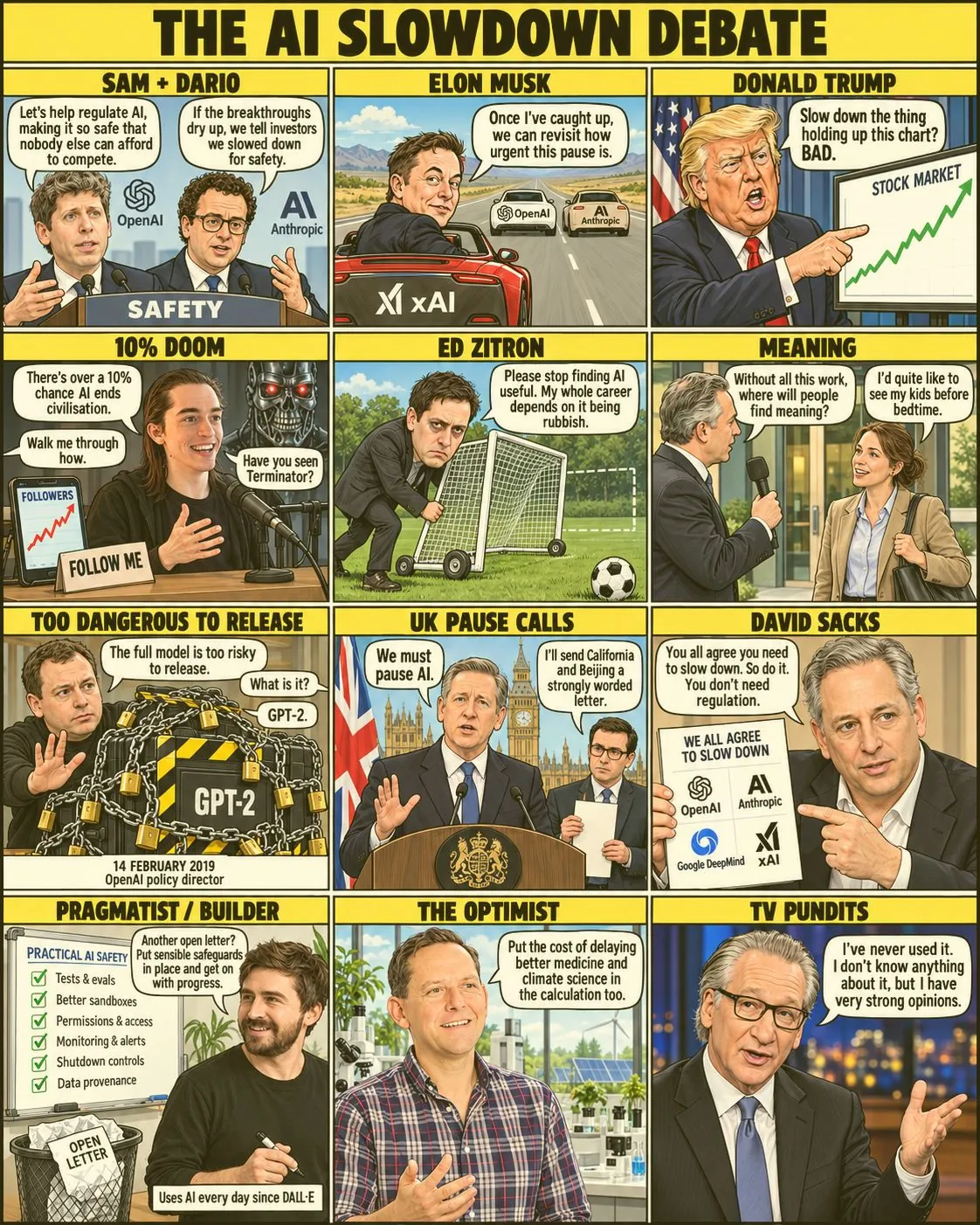
One of his examples was a Swedish trial of more than 105,000 women, where AI-supported screening found 29% more breast cancers than two radiologists reading without AI, with no significant rise in false positives. The other was Cleveland Clinic, which cut risk-adjusted sepsis deaths by about 35% between 2022 and 2025 using AI alerts along with other changes to care. The CDC says sepsis contributes to more than a third of US hospital deaths.
He also pointed out that predicting technology is hard. When the internet arrived, you could have predicted that most shopping would move online. E-commerce is 17% of US retail sales today.
In October 2025 Zitron said the AI bubble would pop "no later than Q2 2026". Vanity Fair asked him on 1 September why anyone should believe him now. He said he'd stopped giving exact time frames because "that was a silly thing to do", and ended his answer with "It will happen. It's just a question of how much money they annihilate."
On 14 September he wrote, "You'll notice I'm a little light on predictions, and that's because everything is a little volatile right now."
DeepSeek showed it last year. R1 came out in January, AI stocks dropped, and plenty called the top. They were wrong.
Last week the AFR said fund managers now fear a bond mess more than an AI pop. That's where the worry sits right now.
Whatever happens in markets, our AI use isn't going down.