
UK police drones in 2026
A police review recorded 60,000 drone missions in 2023. New response trials are testing how quickly drones can reach an incident and help officers on the ground.
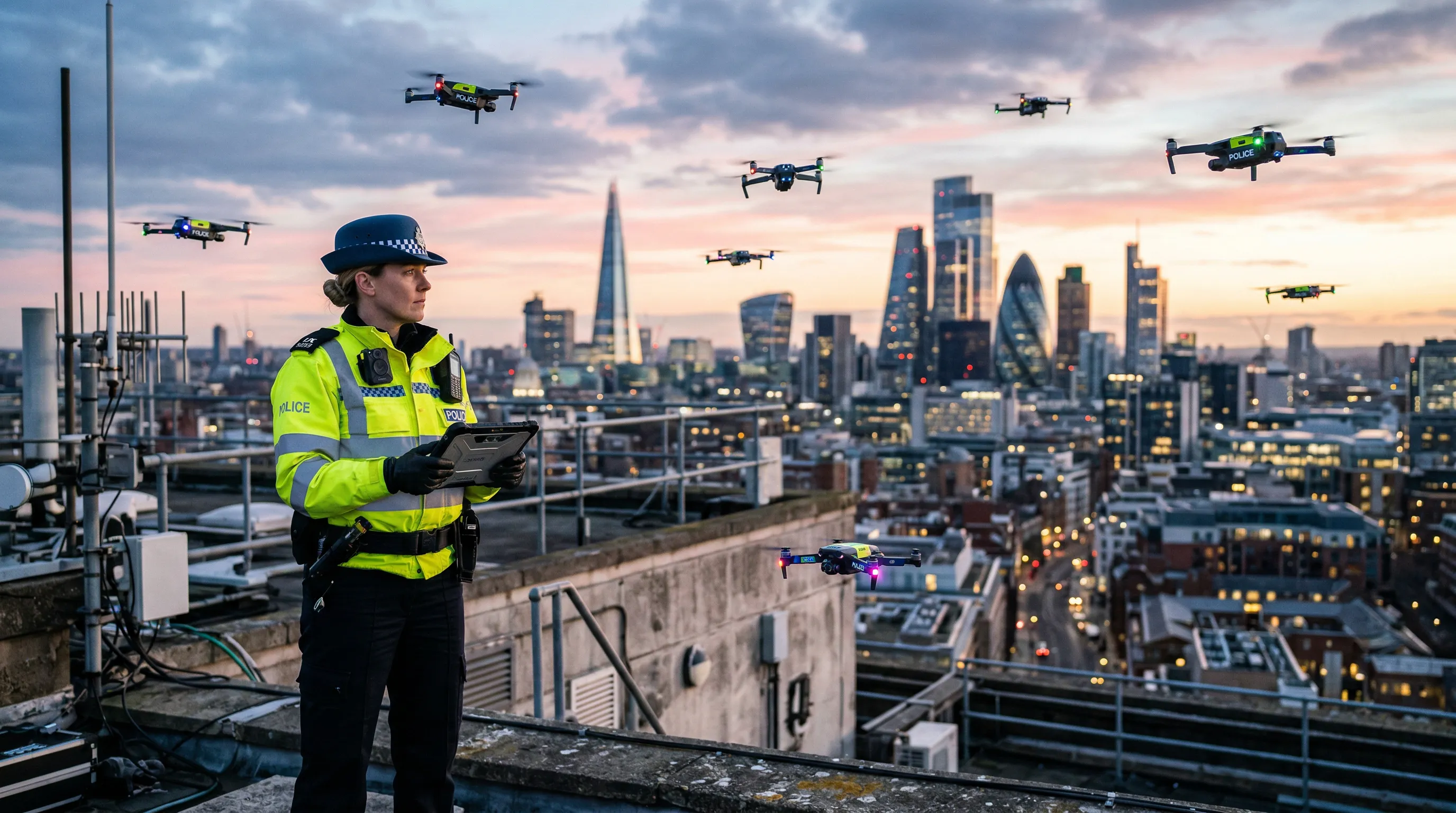
A 999 call comes in. A drone launches from a rooftop dock and reaches the scene before the first police car. That's the idea behind Drone as First Responder.
I'd watch that Netflix movie.
Several UK forces are testing how it works.
The National Police Chiefs' Council reports around 60,000 police drone flights a year and describes first-responder trials in places including Southampton and central London. Response times depend on the launch site, incident location, weather and permissions.[2]
The best crime policy is the one where the crime does not happen in the first place.
Now this really is a Tom Cruise movie, minus the psychics and the creepy jelly bath. The thing that excites me most about this is not even the response. It is the deterrent.

If a camera can reach the scene quickly, an offender has less time to leave unseen. That seems like a useful deterrent, although a drone can't cover every incident or follow someone everywhere.
I can see the appeal when a car is stolen or someone goes missing. I also want clear limits on when police can launch a camera over a neighbourhood.
A drone overhead does not replace a police officer. It tells the control room what is actually happening before anyone arrives. Is the suspect still there? Is it one person or five? Is it escalating? Should we send more units or fewer?
That information can help the control room decide where officers are needed. It still takes people to interpret the picture and act on it.[2]
British Transport Police became the first force to operationalise remote "drone in a box" capability in May 2025, flying drones from a London control room to railway hotspots.[3]
The NPCC describes trials in Norwich, Southampton, the West Midlands and Gravesend. Its Southampton announcement sets a target of less than two minutes from deployment to arrival, using a drone launched remotely from a rooftop.[1]
NPCC has also run trials in Norwich, Southampton, Gravesend and central London. Some of this is still trial phase, some is early deployment, but the direction is clear.[2]
What can we tell from the crime figures?
San Francisco is the best case study we have. In April 2025, SFPD said its Real-Time Investigation Center had assisted in over 500 arrests, including 43 involving drones.[4]
By the end of 2025, the city reported a 25% fall in overall crime and a 44% drop in motor vehicle theft.
Those figures don't isolate the effect of drones. They describe a wider policing system, so they cannot establish how much crime drones prevented.
The knock-on effect is the interesting bit.
Once people know a drone is going to be overhead within a couple of minutes, the incentive to try shifts. Most opportunistic crime relies on a window: get in, get out, disappear before anyone sees you.
A fast aerial response could narrow that window. Whether people actually change their behaviour needs evidence from the deployments.
I'd like to see forces measure that as well as response times and arrests.
The way to build public support is to be transparent from day one.
This only works if people trust it. And trust is not something you earn by rolling things out quietly and hoping nobody notices.
San Francisco publishes its drone policies and its flight logs. You can see when drones flew, where, and why. That is the right approach.[4] NPCC's Centre of Excellence is developing national standards too, which is encouraging.[2]
Publishing the purpose of each flight, retention rules and the complaints process would give residents something they can scrutinise.
We spend a lot of time at Vu thinking about how tech changes the way the world runs. Police drones are one of those things that could genuinely make day-to-day life safer.
Faster missing-person searches and useful evidence are tangible aims. A deterrent effect would be welcome too, if deployments can demonstrate it.
The UK is further along with this than most people realise.