Waymo reported 220.6 million driverless miles through March 2026 and 94% fewer crashes causing serious or fatal injury than its matched human-driving benchmark. People in Neuralink's clinical trials are controlling computers using implanted devices. And Casgevy, the first FDA-approved CRISPR treatment, prevented severe pain crises for at least 12 consecutive months in 29 of the 31 evaluable sickle-cell trial participants. That is a treatment result, rather than a guarantee of a cure for every patient.
These are advances with real users and patients. Much of the AI conversation still centres on job losses and cheating on essays.
Many of the people making bold predictions also have something to sell. Sam Altman backs fusion. Elon Musk sells a robotics future. Jensen Huang sells the chips. Their interests don't make the predictions wrong, but I'd keep them in mind.
Investors are funding attempts to make these ideas work. Helion's June 2026 funding round valued the fusion company at $15.5 billion. A valuation measures investors' expectations, though. It doesn't mean a power plant has delivered electricity.
Every child gets a tutor
Sal Khan's ambition is a patient AI tutor for every student and an assistant for teachers. Khanmigo is an attempt to put that into practice. Reaching more children is an attractive prospect; the teaching quality still needs measuring.
Medical progress
DeepMind's AlphaFold database contains more than 200 million predicted protein structures. Predictions give researchers a starting point; they don't replace experiments. Demis Hassabis and John Jumper received half of the 2024 Nobel Prize in Chemistry for protein-structure prediction.
I can see why people hope for much faster medical progress. Moving from a promising prediction to a treatment still takes laboratory work, trials and evidence that it is safe and effective.
Brain interfaces
Edward Chang's team at UCSF helped develop a brain-to-voice neuroprosthesis that decoded attempted speech in a participant with paralysis. It is an experimental system, but being able to communicate again is a tangible result.
More robots
Figure reports that its robot spent eleven months at BMW, handling sheet metal used in more than 30,000 X3s. In June 2026, it announced a new deployment at the same plant. I'd pay more attention to jobs a robot can keep doing on a real line than to forecasts of billions of future units.
Cars
Waymo raised $16 billion in February 2026 at a $126 billion valuation. It is already operating a paid driverless service. The next question is how widely and economically that service can expand.
Ageing as an engineering problem
XPRIZE Healthspan is a $101 million competition seeking treatments that restore at least a decade of muscle, cognitive and immune function in adults aged 50 to 80. It is a research goal, not a treatment available today.
Energy
Helion's electricity purchase agreement with Microsoft targets initial power production in 2028. That is an ambitious company target. Demonstrating a commercially useful fusion plant remains the hard part.
Robot labs
Self-driving labs let a researcher set a goal and hand off a sequence of experiments to machines. NC State's PoLARIS lab searched a space of billions of possible recipes and found brighter lead-free nanomaterials in about 120 experiments over 12 hours. People still chose the research problem, built the system and evaluated the result.
Water
Researchers at the University of Rochester have demonstrated solar desalination that collects salt as a solid rather than discharging concentrated brine. It is a research system; scaling it for reliable water supply is a further task.
The jobs nobody can picture yet
But what happens to work?
Spotting a job that might disappear is easier than naming one that doesn't exist yet. That makes forecasts of loss feel more concrete than forecasts of new work, even though neither is certain.
Write a job advert for 2049: Synthetic Lineage Officer, hybrid, £115,000 to £145,000, owning the compliance chains between an organisation's AI agents and the humans accountable for them. Reads as nonsense today (and probably is, which is the point of this exercise). So would "Customer Success Manager" in 1985.
I would like a future where less of the working day is spent on work nobody enjoys.
And where useful tools let more people make things they couldn't make before.
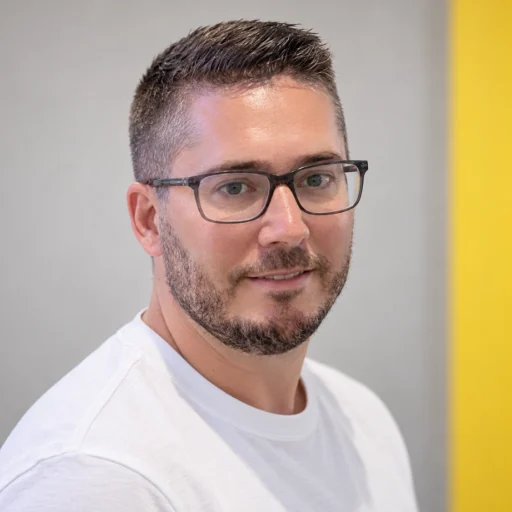
Phil Webb
The optimistic case is not that disruption will be painless, or that every displaced worker will neatly step into a better-paid job. Hopefully nobody believes that the current jobs are the pinnacle state of humanity. Surely there are more interesting things for our children to become than [INSERT JOB HERE] (I don’t want to offend anyone).
Aside from the fact that the people who are fully embracing AI are working more than ever, human wants are elastic, status games are infinite, and once technology makes one layer of work cheap or unnecessary, we invent another. We did not move from farms to factories to offices because the universe handed us a fixed list of occupations. We made them up, then treated them as obvious. The future probably will not look like today’s labour market with a few new titles bolted on and it may look stranger (from today’s perspective), but no stranger than how people in previous generations looked at our work.
We invented much of today's office work. I doubt we've finished inventing things to do.